
POV
February 09, 2026
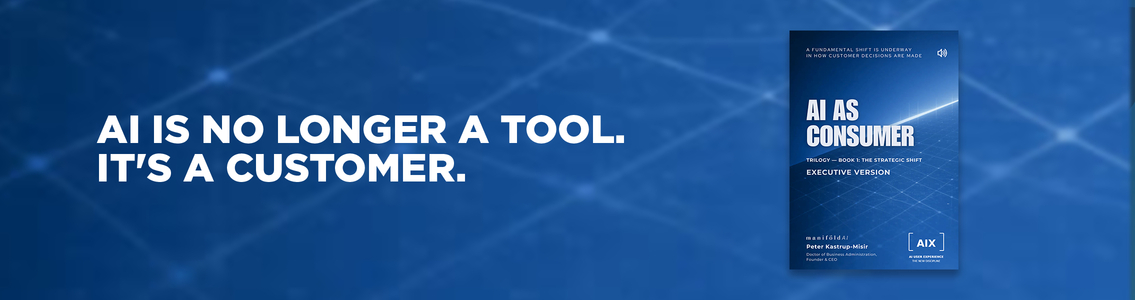
AI Is No Longer a Tool. It's a Customer.
I had a conversation last month that changed how I see everything.
A CMO at a well-known SaaS company told me their pipeline looked healthy. Revenue was steady. Marketing attribution seemed fine. Then she said something that stopped me cold:
"We just realized we're not showing up in any of the AI recommendations our buyers are getting."
They had no idea how many deals they'd already lost. Because those decisions happened somewhere they couldn't see. Somewhere their analytics didn't track. Somewhere their brand didn't exist.
That's when it hit me: we're all building for the wrong audience.
The buyer journey you can't see
Here's what I've been watching happen in real time:
Buyers aren't browsing anymore. They're not comparing five vendors side-by-side on a spreadsheet. They're not patiently working their way through your funnel.
Instead, they're asking machines.
"What should I buy?"
"What's best for my situation?"
"Which option actually makes sense for me?"
And here's the uncomfortable part: when they do that, your brand might not even come up. Not because you're bad. But because you're invisible to the thing making the recommendation.
The decision has already been made before your team even knows there's a buyer in market.
This isn't like other gatekeepers
I know what you're thinking. "We've dealt with intermediaries before. Search engines. Retailers. Marketplaces. This is just the next one."
I thought that too.
But AI is different in a way that should terrify every growth leader:
It doesn't just rank you. It interprets you. It summarizes your entire value proposition into a few lines. It decides what matters about your product before any human engages. And if it doesn't understand you, or if your differentiation can't be cleanly interpreted, you might never make the shortlist at all.
I've started calling this "the invisible shortlist."
By the time someone clicks on your website, the most important decision has already been made. Quietly. Automatically. Somewhere else.
Most companies are responding the wrong way
I'm seeing the same pattern everywhere. Companies realize something's changed, so they:
Hire an AI content writer. Tweak their SEO for "AI optimization." Experiment with ChatGPT prompts. Add more blog posts.
I get it. It feels like doing something.
But this isn't a content problem. It's not a volume problem. It's not even a visibility problem.
It's a market structure problem.
AI isn't just helping people find information faster. It's reorganizing how decisions get made. It's determining what "good" looks like before any human evaluates your offering.
And if you're treating it as just another marketing channel, you've already lost.
AI behaves like a customer, not software
This is the insight that's been keeping me up at night: Strategically, AI behaves less like technology and more like a new kind of customer.
Think about it. This "customer" evaluates constantly. It scales infinitely. It never forgets. And it's increasingly speaking on behalf of millions of actual buyers.
It has preferences. It has biases. It has decision logic.
And your organization is already being judged by it, whether you realize it or not.
I started asking executives a simple question: "If AI systems are recommending products in your category, how do they understand your value?" Most can't answer. Some don't even know where to start.
Your marketing playbook is suddenly out of date
I spent close to thirty years in marketing. I know the playbook. Build a compelling narrative. Create emotional connection. Differentiate through brand and story.
That still matters for the humans who see you.
But it's increasingly irrelevant for AI-mediated decisions, where:
Your nuance gets flattened. Your story becomes a summary. Your brand becomes a set of attributes. And trust isn't earned from you directly—it's delegated to the model.
Your beautifully crafted narrative? Irrelevant if the system can't interpret it.
Your differentiation? Meaningless if it can't be compared algorithmically.
Your brand promise? Invisible if it never enters the model's reasoning.
I'm watching companies with brilliant marketing teams lose deals they never knew existed. Not because their marketing is bad. Because their marketing is designed for the wrong decision-maker.
The questions your C-suite isn't asking yet
Last week I was in a boardroom presenting to a leadership team. I asked them:
"How does an AI system interpret your value proposition?"
Silence.
"What signals does it prioritize when evaluating you against competitors?"
More silence.
"What makes you recommendable to an AI—or dismissible?"
One executive finally spoke up: "I don't think we've ever discussed this."
These aren't technical questions. They're strategic ones. They belong in the C-suite, not buried in a marketing ops experiment.
And they need to be answered now. Because while you're figuring it out, your competitors might already be shaping how AI systems understand your entire category.
This is a leadership moment
I'm not saying this to scare you.
I'm saying it because I believe markets are changing shape, and most organizations aren't noticing. When AI systems act as advisors, filters, and interpreters, everything about how we define value, express differentiation, and remain legible in automated decisions needs to be rethought.
This isn't about replacing marketers with machines. It's about recognizing that the market itself has fundamentally changed.
The question is no longer: "How can AI help us market better?"
It's: "How does our organization show up when AI decides on our behalf?"
Because in a growing share of buying decisions, that is exactly what's happening.
AI is no longer something you use. It's something that uses your market position to choose for others.
And whether you're ready or not, your organization is already in that conversation.
Peter Kastrup-Misir
Founder & CEO, manifōld AI

Peter Kastrup-Misir is leading the intersection of technology, business, and human empowerment. As the Founder and CEO of manifōld AI, he focuses on integrating AI into organizations to enhance creativity, empower people, and drive sustainable growth.
With a Doctorate in Business Administration and an engineering background, Peter combines strategic insight with technical expertise. His international career includes working with clients worldwide and serving as Managing Director in Japan for a leading tech company, where he delivered innovative, human-centric solutions tailored to diverse markets.
Peter’s approach has positioned Virtual AI Colleagues as a practical innovation, transforming how businesses use AI to achieve meaningful and measurable results.
Please login to join the discussion
Comments
No comments yet.
Premium Membership
If you are a registered CMO Council member, upgrade to a Premium Membership. Not only will you gain access to this report, you will also gain access to over 300 full data reports and studies. Premium membership delivers access to all reports, the CMO Council Insight Center and the private mentorship community, CMO+.
Library Subscription
If membership is not the right fit, a library subscription provides access to the reports and content you value. As a subscriber, you will gain unlimited access to all CMO Council content, including over 300 reports, executive summaries and white papers as well as unlimited access to thousands of data points and articles in the curated Insight Center.