POV
February 12, 2026
How to Value Creative Work
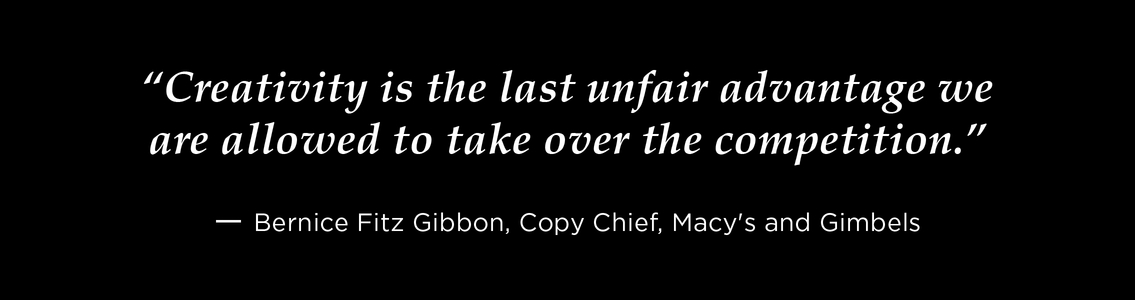
This 75 year-old quote couldn’t be more applicable today. If marketers have maxed out efficiencies gained with technology and in media spending, effective creative work is the only advantage left. But unlike cutting costs or getting more for less, the expense of high-quality creative work is much harder to quantify and justify on the balance sheet. Like any other investment, it should be accountable to a measurable financial return.
Yet we don’t measure the financial value of creative work—something every other creative industry does.
We pay for creative work the way we pay for unskilled labor.
For the past thirty years, creative work has been purchased by the hour. Which can’t help but incentivize labor over effectiveness. We know that zero-cost, low-quality creative with a $1M media spend will underperform $100K high-craft creative with a $500K spend. We know that “filler” creative that doesn’t outlive the media flight is not an ongoing brand asset. We know that “cheap” creative is often the most expensive mistake a brand can make. We know that media costs the same whether the creative work is effective or not.
We know all that but we don’t measure how creative work multiplies the value of the media buy, we measure how long it took to do.
We judge creative work with no relation to return on investment.
When we look for "proof" of creative quality, we usually turn to two metrics: pre-testing and awards. One is a predictive simulation in an artificial environment and the other is a peer-review of work. While both have their place, and can be valuable proxies for quality, neither is a financial measure of effectiveness.
We separated creative work from the media it was made for.
Creative work is designed to gain attention, engagement, and interaction. It’s designed to add equity to brands. It can’t do any of that without media. But great creative earns attention that isn’t purchased through media spend alone, it earns attention that can’t be purchased. Great creative multiplies the media spend.
Back in the old days, when creative work was paid by commission, as a percentage of the media buy, it was much easier to see the effectiveness of great creative. When a campaign was effective, media spends were increased. Since then, the evolution of the media landscape has changed a lot of things but creative and media still work hand-in-hand, yet are judged and valued in isolation.
Media and creative are symbiotic.
Other creative industries value creative work by its in-market performance. Music is valued by streams and royalty participation. Film is valued by box office sales and viewership. Publishing is valued by copies sold. In these industries, the unit of consumption translates directly to financial worth. No, we shouldn’t measure creative work by sales—we all know there are too many other factors at play. In those other industries the creative work is the product itself. Our creative work is, say, the equivalent of the poster for the movie. It should be valued by how well it achieves what it was designed to do: gain attention, engagement, and interaction. It should be measured by any equity it gains above and beyond the media spend.
We already have a way to measure those things. Like media, creative success can be measured by CPM. We audit media spend to the third decimal point, verifying every impression and cent spent, but we treat creative work as an overhead expense, instead of treating it as an asset.
We now have the data and technology to change that.
Measuring Creative CPM.
Creative CPM (CCPM) assigns a standardized financial value to each outcome the creative work achieves.
It uses three-inputs:
The Total Production Cost:
Every dollar spent on the concept, talent, and agency fees (the capital invested).
The Total Media Spend:
The cost of distribution.
The Creative Outcomes:
The outcomes gained across paid, owned, earned, and shared channels.
CCPM assigns current market values to each outcome. Whether it’s a video view completion, a high-intent site visit, deep engagement, or dwell time, organic shares, or unpaid media coverage, it’ll be given a specific value, based on global media benchmarks. By aggregating these valuations, we arrive at a single number, a Creative Multiple of the media spend, which shows how effective the creative was.
What does this Creative Multiple measurement do?
It restores the economic link between creative quality and financial outcomes for the first time since the agency commission era.
It shows whether your creative work leveraged your media spend, or if it was not worth the money spent on media. And reveals how much value your creative investment is generating beyond the paid media reach, production and fees. (Using this tool, we’ve seen great creative work show a 3.84x return on the total communication investment—including media.)
It allows marketers to financially quantify quality creative work, to manage marketing budgets as a series of investments, and to compare different creative executions. And justifies the cost of effective creative work, enabling the creation of brand assets that keep working to build equity, rather than creative work that has no value after the media flight is done.
Learn More at Creative CPM
Corey Mitchell
Founder, Creative CPM

Corey Mitchell started as an assistant finished-artist Down Under, working his way up to be President of three New York advertising agencies (traditional and digital), one of which was the most creatively awarded agency in the world under his leadership. After two decades of championing great and effective creative work, and a decade of consulting for marketers struggling to find their creative footing in an evolving market, he founded Creative CPM
Please login to join the discussion
Comments
No comments yet.