POV
November 06, 2026
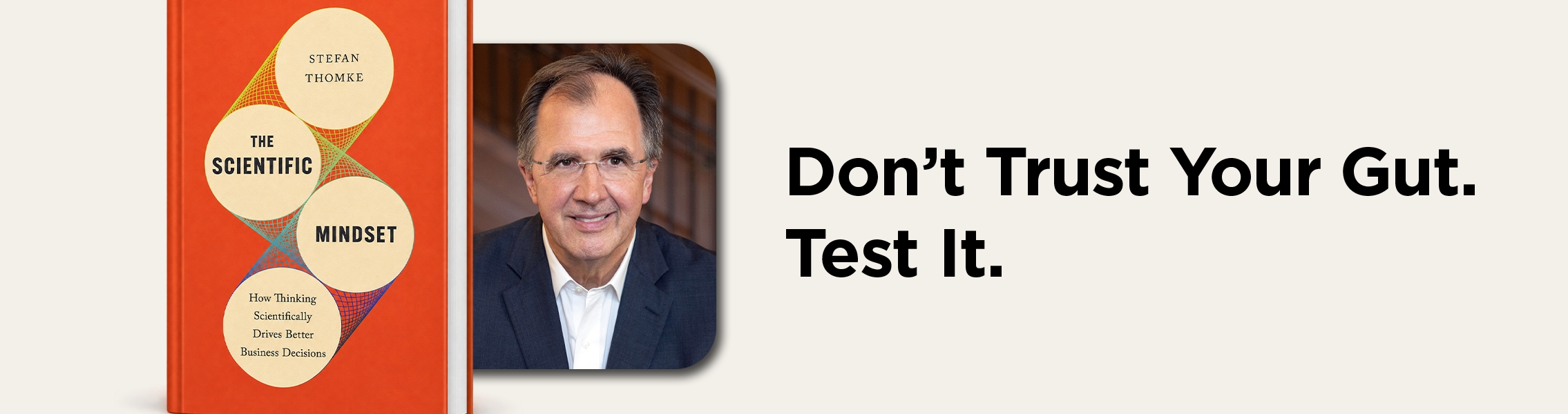
Don’t Trust Your Gut. Test It.
Every day, growth leaders make decisions about products, customers, resource allocation, hiring, employee pay, and more, basing them on causal assumptions they have rarely, if ever, critically examined—much less challenged. These decisions are consequential when they commit organizations and people to a set of difficult-to-reverse actions. An executive may, for example, replace a business unit manager with a star performer lured from a competitor, assuming that this will lead to better financial results (actually, research has shown that it may not). “I’ve always been successful doing it this way” is what we often hear when people are asked why they didn’t question practices that turned out to be faulty or refused to try something new. Or they may insist that “this idea will never work” because of a failed attempt that embarrassed or frustrated them in the past. People recognize the importance of questioning their assumptions when knowledgeable skeptics show that the ideas behind current practices are flawed or outdated—instead of simply digging in their heels.
If systematically challenging assumptions is so valuable, why don’t leaders make it a standard operating procedure? After decades of studying, teaching, and advising business leaders, I’ve concluded that the fundamental reason is that many leaders don’t think or act scientifically. They are often reluctant to challenge their assumptions or to fund experiments that may prove them wrong. Despite decades of admonitions about the dangers of gut instinct, they continue to overrely on intuition and personal experience in decision-making. People with a scientific mindset, by contrast, are knowledgeable skeptics who demand hard evidence. They are deeply committed to practicing the scientific method, which includes guesses, observation, testable hypotheses, experiments, and analysis.
A scientific mindset can challenge a leader’s legitimacy, since their position in the corporate hierarchy is often assumed to be the result of experience and a track record of many successful moves and ideas. They are frequently hired for a playbook they used elsewhere and are expected
to repeat it. At the same time, leaders operate within a feedback loop of positive reinforcement that makes them—and those around them— unlikely to question the assumptions underlying their decisions. Practicing the scientific method, in comparison, requires intellectual humility in the face of difficult problems and relies on an objective, evidence-based process, rather than predominantly personal insight, to frame and make decisions.
Leaders should also be unafraid to admit that they don’t know the right decision and invite others to think and act scientifically. But this is easier said than done. The problem is, as Ed Bastian, CEO of Delta Air Lines, observed, leaders are expected to have all the answers: “If you say ‘I don’t know,’ that doesn’t necessarily inspire confidence. But it’s so important when you are honest. . . . Saying ‘I don’t know’ is one of the hardest things a leader can do.”
Situational Arrogance
Consider what can happen when a leader relies solely on experience and intuition in the face of uncertainty. When Ron Johnson left Apple to become the CEO of department store chain JCPenney in 2011, he led his management team in implementing a bold new plan. The company eliminated coupons and clearance racks, filled stores with branded boutiques, and used technology to eliminate cashiers, cash registers, and checkout counters. Yet after just seventeen months, sales had plunged, losses had soared, and Johnson had lost his job. How could JCPenney have gone so wrong? What about Johnson’s experience in cocreating the highly successful Apple Store concept, which redefined the customer in-store experience with innovations like the Genius Bar and cashier-free checkout? Those decisions led to the highest retail sales per square foot of any store, and attracted more visitors than Disney’s theme parks.
JCPenney’s board of directors must have hoped that Johnson would repeat Apple’s retail success at the old department store chain, with its more than one thousand US locations. Why didn’t that happen? According to Johnson, his overconfidence contributed to JCPenney’s demise:
You can have what I call “situational arrogance.” It’s when
you think, based on your experience and your contacts, that
you know exactly what’s right. . . . But there is a lot of luck
in business. . . . You’ve got to be careful you understand why
those things worked and you don’t give yourself too much
credit. I was informed by 25 years of good luck, good success,
but that led to situational arrogance in my point of view about
JCPenney.
Johnson cautioned leaders who put too much faith in experience. His experience isn’t an outlier. A central activity of leadership is making decisions in situations where their consequences are ambiguous. On any given day, senior managers and entrepreneurs have to make tough decisions because subordinates are unable to come to a conclusion or lack authority to do so, or both. Should a major product launch be delayed? How should a new service offering be priced? Can employees work from home? A leader’s approach to decision-making is often intuitive: they apply experience to new circumstances or rely on assumptions associated with successful outcomes in the past.
The Scientific Mindset
When leaders think scientifically, they recognize that human beings make cognitive and judgmental errors and can drift into complacency built on flawed assumptions. Such leaders relentlessly probe intuition and change assumptions if evidence shows they’re wrong. Unbridled curiosity drives out strong opinions and biases. Intellectual humility replaces hubris and unjustified pride. For Francis Bacon, the seventeenth-century natural philosopher who pioneered a version of the scientific method, the decision process begins with an admission of doubt: “If a man will begin with certainties, he shall end in doubts; but if he will be content to begin with doubts he shall end in certainties.”
In my research, I have identified five elements of a scientific mindset that are particularly useful in management practice: be a knowledgeable skeptic, articulate testable hypotheses, produce hard evidence, probe cause and effect, and build an experimentation culture. For leaders to think and act scientifically means following those practices, which are discussed in my new book The Scientific Mindset (HBR Press, 2026). The book explains them using examples from science, business, and other fields and discusses why they are vital for decision-making.
The article’s content comes from THE SCIENTIFIC MINDSET: How Thinking Scientifically Drives Better Business Decisions by Stefan Thomke (HBR Press, 2026).
Stefan Thomke
William Barclay Harding Professor of Business Administration at Harvard Business

Stefan Thomke is a leading authority on the management of innovation and the William Barclay Harding Professor of Business Administration at Harvard Business School. A management educator, speaker, and advisor to global leaders, his pioneering research has inspired organizations across industries to incorporate experimentation and scientific thinking into how they make decisions. Stefan has published more than one hundred articles, cases, and notes, and is the author of four books: Experimentation Matters (2003), Managing Product and Service Development (2007), Experimentation Works (2020), and The Scientific Mindset (2026). Experimentation Works was recognized by Forbes as one of the top technology books of 2020, as a top business book of 2020 by Inc. and CEO magazines, and became a Top Shelf Pick by Strategy & Business.
Please login to join the discussion
Comments
No comments yet.